
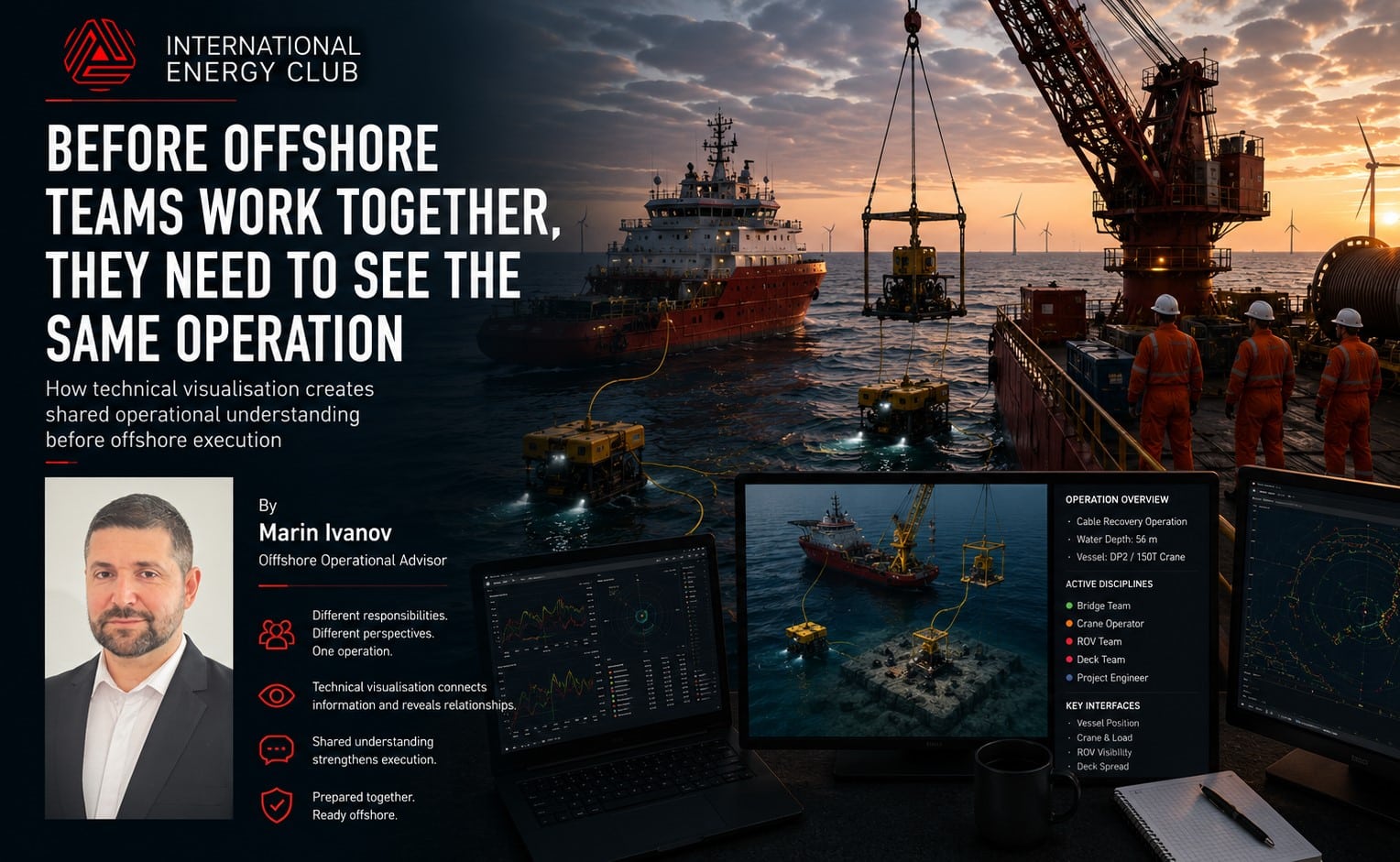
How technical visualisation creates shared operational understanding before offshore execution
By Marin Ivanov | Offshore Operational Advisor
Offshore operations bring together people with different responsibilities, technical backgrounds and priorities. Before execution begins, these disciplines may review the same plan, attend the same meetings and agree on the same intended sequence. Yet each approaches the operation through the responsibilities they will carry once the work starts.
A project engineer may focus on the planned sequence. The bridge team considers vessel position, heading, environmental conditions and marine traffic. The ROV team looks at subsea access and visibility. Deck personnel consider equipment movement, deck layout and working areas. The client representative needs confidence that the agreed scope can be executed as intended.
Even after reviewing the same operation, each may still carry a different operational picture.
This is where technical visualisation can provide value far beyond presentation. When it accurately represents the intended operation, it gives different disciplines a common reference for examining sequence, interfaces, constraints and consequences before offshore execution begins.
Its greatest contribution goes beyond helping people see the operation: it helps them think about it together.
The difference between information and understanding
Offshore preparation already produces considerable information: method statements, technical drawings, risk assessments, equipment specifications, task plans, presentations and operational limits.
Each document has a defined purpose. However, shared understanding rarely emerges automatically from information distributed across several documents.
People naturally interpret a plan through the responsibilities they will later carry. The bridge team may concentrate on position keeping and vessel movement. The crane operator considers load behaviour and lifting geometry. The ROV team examines subsea access, visibility and equipment interaction. The deck team looks at how the equipment will be handled within the available working area.
Each discipline may understand its own part correctly while still forming a different mental picture of how the complete operation will unfold.
A technically accurate animation or 3D visualisation can bring these separate interpretations into one operational context. By connecting the underlying documents, it allows the relationships between activities to be seen and questioned.
Its purpose is to make the complexity sufficiently visible for people to examine and discuss together.
When available information still leaves different pictures
Earlier in my offshore career, while standing a DP bridge watch, I participated in the recovery of a section of subsea cable between two wind turbines that had been isolated for the operation.
The operation brought several systems and disciplines together within a constrained offshore environment. A subsea trenching spread was deployed using the vessel’s 150-tonne offshore crane to expose the cable. One ROV observed the trenching activity and was later fitted with a cutting tool, while a second ROV remained on standby on the seabed. A cable-recovery spread and carousel had been installed on deck. Other vessels were also carrying out work within the surrounding wind farm.
The Offshore Installation Manager coordinated the operational sequence. On the bridge, our responsibilities included maintaining the vessel’s position and heading, monitoring the surrounding traffic and maintaining operational communications with the teams involved in the execution.
The task had been prepared through a method statement, technical drawings, a presentation and toolbox discussions. The necessary information was available. Yet some personnel were participating in this type of operation for the first time. They could understand the instructions connected with their individual roles, but it was more difficult to form a complete mental picture of how the vessel, crane, trenching equipment, ROVs, cable and deck spread would interact throughout the sequence.
An accurate technical visualisation could have connected those separate pieces of information before execution began. It could have shown the spatial relationships, sequence of activities, operational handovers and how a change in one part of the operation could affect the others.
The method statement, the authority of the Offshore Installation Manager, the judgement of the bridge team, the live ROV feed, load information and continuous communication would still have governed the operation. The visualisation would have given everyone a common operational starting point before real-time decisions had to be made.
Making the interfaces visible
Many difficulties during offshore execution emerge at the interfaces between disciplines rather than within one technical area.
A change in vessel position or heading can alter the geometry between the vessel, crane wire, subsea equipment and worksite. A crane movement can affect the conditions being observed by the ROV. A subsea development can require the planned sequence to pause while the surface teams reassess the next step. Cable handling on deck depends on what is happening below the surface, while the teams involved observe the operation from different physical positions.
No single participant necessarily holds the complete operational picture. From the bridge, we could monitor the vessel, the surrounding traffic and the operational communications, but we depended on the ROV feed and information from the other teams to understand what was happening at the subsea worksite. Other teams, in turn, depended on the bridge to maintain the agreed vessel position and communicate changes that could affect the operation.
The deck and cable-handling teams also needed confirmation that the subsea and lifting conditions were ready before continuing their part of the work.
Technical visualisation can make these dependencies visible before they become immediate operational demands.
When teams examine the same visual sequence, they can ask more precise questions:
- What must be confirmed before this stage begins?
- Which other activity could affect it?
- Who needs the same information at this point?
- Where does responsibility pass from one team to another?
- What changes if the expected sequence needs to pause or change?
- At which points is an operational decision required rather than a routine procedural step?
Together, these questions test execution readiness rather than visual quality.
Visualisation as part of operational review
Technical animations are often developed after the operational concept has already been established. In that situation, their purpose may be to explain an approved methodology to clients, personnel or other stakeholders.
But visualisation can contribute earlier.
A draft visual sequence can become part of the multidisciplinary review process. Bridge personnel may identify a vessel-positioning consideration. An ROV specialist may question the proposed subsea approach. Deck personnel may notice that an equipment route or working area requires further attention. A project engineer may recognise that a planned transition depends on information that remains unconfirmed.
The visualisation brings existing issues into a common space where they can be recognised and discussed.
This is an important distinction. The finished animation communicates the intended operation. The process of developing and reviewing it can also test whether the operational logic is understood consistently across the disciplines involved.
A difference in interpretation identified during preparation is useful information. The same difference discovered offshore must be resolved under environmental, technical and time pressure.
Accuracy matters more than appearance
A polished visualisation can be persuasive, yet operational accuracy requires more than visual quality.
If vessel behaviour, equipment movement, worksite geometry or task sequence are represented unrealistically, the result may create confidence without creating understanding. It may show what the operation is expected to look like while concealing the conditions required to make it work.
For this reason, technical visualisation should be reviewed by the disciplines whose activities it represents. Their contribution ensures that simplification preserves the information needed for sound operational thinking without adding unnecessary complexity.
A useful visualisation should help teams distinguish between:
- the planned sequence and the conditions required to support it;
- individual activities and the interfaces between them;
- confirmed information and operational assumptions;
- routine stages and points requiring a decision;
- the expected operation and circumstances that may require it to pause or change.
The objective is to improve preparation by allowing the plan to be examined from several operational perspectives while changes remain possible. Actual execution will always contain more variability than any animation can reproduce.
Where operational responsibility remains
The contribution of technical visualisation needs to be understood within clear operational limits.
Decisions about environmental limits, verified loads, unexpected subsea conditions and whether an operation should continue, pause or change remain with the competent personnel using live operational information.
What visualisation can do is improve the common mental model from which those people begin. It can help them understand in advance what information others will hold, where operational dependencies exist and why a decision made by one discipline may affect several others.
That is a practical distinction. Operational decisions remain with the team, while visualisation can help its members reach the point of decision with a more consistent understanding of the operation.
Shared context across different expertise
Each discipline retains its own expertise and responsibilities. The requirement is sufficient shared context for bridge, project, ROV, crane and deck personnel to understand how their respective decisions affect the wider operation.
Technical visualisation can provide that context. It allows specialists to contribute from their own expertise while examining the same operational sequence. Communication becomes more precise because the discussion can be connected to a specific movement, interface, dependency or decision point.
It also makes disagreement more valuable. If two disciplines interpret the same visualised stage differently, that disagreement identifies where further alignment is required.
Disagreement identified during preparation can be examined. Misunderstanding discovered during execution must be managed under pressure.
From visual communication to offshore readiness
The operational value of technical visualisation extends beyond the clarity of the finished plan to the quality of the questions and conversations it generates before execution.
Used at the right stage, it can support multidisciplinary reviews, readiness discussions, operational workshops and pre-execution briefings. It can help teams identify which parts of the plan are well understood, which interfaces require further attention and where an apparently clear sequence still depends on unspoken assumptions.
For senior leaders, this is where visualisation becomes more than a communication deliverable: it provides an earlier opportunity to test alignment before uncertainty reaches the vessel.
For project and vessel management, the practical value lies in surfacing cross-disciplinary assumptions before mobilisation, while there is still time to clarify responsibilities, challenge the sequence and adjust the plan.
The strongest technical visualisations therefore do more than show how an offshore operation is intended to happen.
They help determine whether the people responsible for delivering it understand that intention in the same way.
Because before offshore teams can work together effectively, they first need to think together.
And thinking together begins with seeing the same operation.
ABOUT THE AUTHOR

Marin Ivanov
Offshore Operational Advisor | Former Chief Officer/SDPO
Marin Ivanov is an Offshore Operational Advisor and former Chief Officer/SDPO with more than a decade of maritime operational experience, the majority gained in offshore operations across PSV, Walk-to-Work and ROV/IMR subsea vessels. His background includes DP operations, offshore campaign execution, SIMOPS, and operational participation in DP Annual Trials and FMEA proving trials as a senior bridge officer. Having worked at the interface between bridge, deck, project and subsea teams, he now focuses on operational readiness, cross-disciplinary alignment and practical decision-making before offshore execution.