
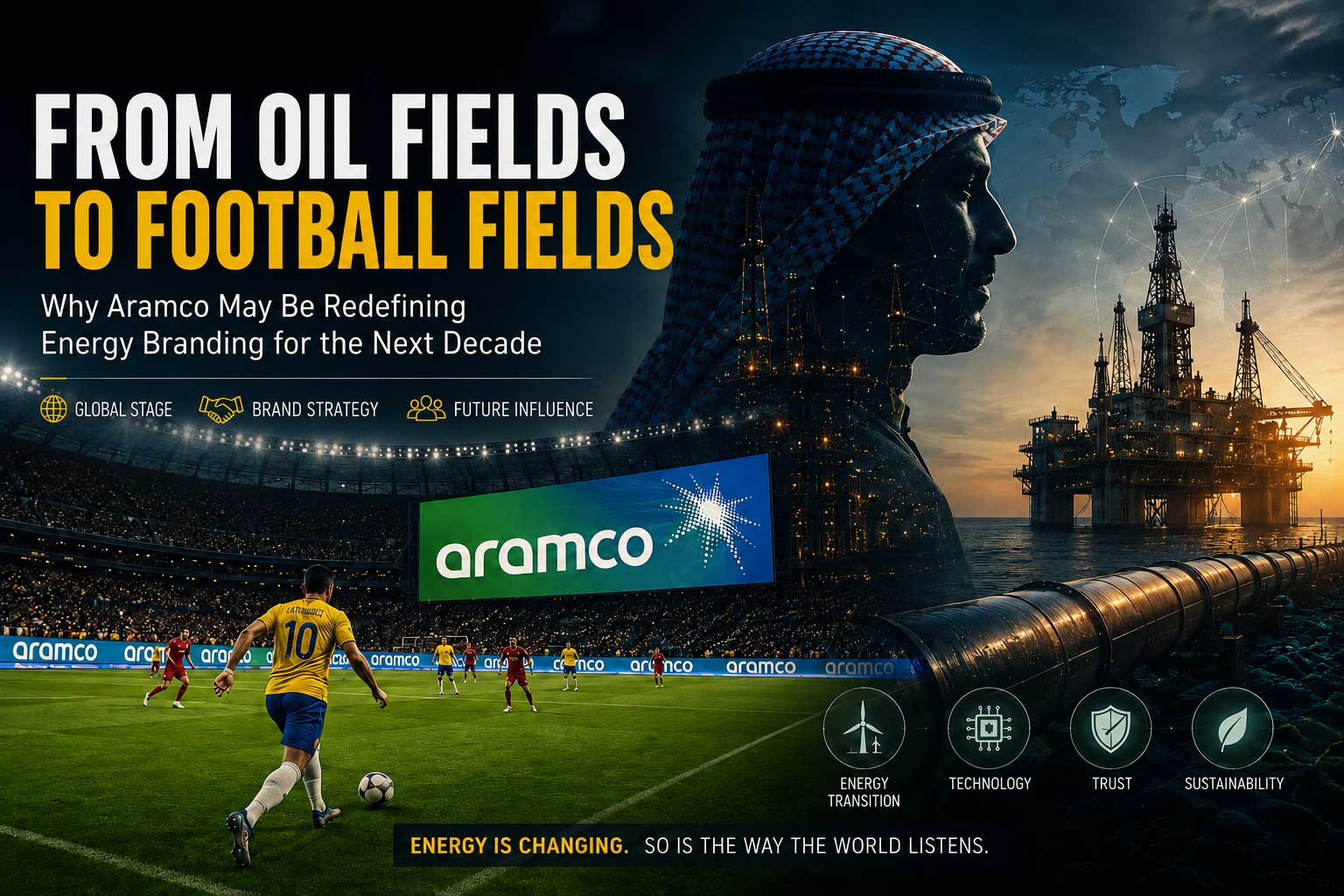
Aramco: From Oil Fields to Football Pitches
By Mohammad Sadegh Amini
Founder & Director of Projects, International Energy Club
Late at night, after long hours of demanding work and the considerable responsibilities that come with leading the International Energy Club, I often find myself physically and mentally exhausted. My days are filled with online meetings with senior executives from some of the world’s largest energy companies, internal strategy sessions, and supervising the production of highly specialized industrial animations—projects that must be delivered within tight deadlines without compromising even the smallest technical detail or visual quality.
Despite that exhaustion, I still enjoy watching some of the FIFA World Cup matches. Not because I am merely a football fan, but because, for a few hours, football allows my mind to step away from oil and gas projects, offshore engineering, and the constant demands of the global energy industry. Yet over the past few evenings, something other than the football itself captured my attention. Throughout almost every match I watched, one corporate name appeared repeatedly on the advertising boards surrounding the pitch.
Aramco.
Not discreetly.
Not occasionally.
But with an unmistakably dominant, carefully orchestrated, and highly visible presence.
That observation immediately raised a question in my mind: Why would one of the world’s largest oil companies invest billions of dollars simply to be seen during the world’s biggest football tournament? Why would a company whose primary product is crude oil choose football as its advertising platform?
At first glance, the idea appears almost paradoxical. After all, football fans are not going to leave the stadium and purchase crude oil simply because they have seen the Aramco logo during a match. Yet behind these multi-billion-dollar sponsorship investments lies a remarkably sophisticated branding strategy. Over the past several days, I have spent considerable time researching this subject, and I would like to share the results of that research with my dear followers here.
Why Does FIFA Allow Oil Companies to Advertise?
Many readers may wonder why FIFA allows an oil company to advertise at the world’s largest sporting event. The answer is actually quite straightforward. Although FIFA is fundamentally a sporting organization, staging the world’s biggest football tournament would be almost impossible without substantial private-sector investment. Companies such as Aramco, Adidas, Coca-Cola, Visa, Hyundai, and numerous other World Cup partners finance a significant portion of the tournament’s enormous operational costs.
However, the history of major energy companies entering the world of sport tells a far more fascinating story than simple commercial sponsorship. What began during the 1970s as little more than conventional product advertising has gradually evolved into something far more strategic—a powerful instrument of corporate diplomacy, global reputation management, and, increasingly, even national image-building. To better understand this evolution, we can divide the relationship between energy companies and global sport into three distinct historical phases.
Phase One (1970s–1980s): Shell and the Age of Mechanical Performance
Shell was among the first major oil companies to recognize the commercial value of sports sponsorship. Its early involvement in motorsport—particularly Formula One—was entirely logical. The company’s objective was simple: If Shell fuels and lubricants could perform under the extreme conditions of Formula One racing, consumers would naturally believe they would perform exceptionally well in their own vehicles. The target audience was clear: ordinary motorists visiting petrol stations every day.
During this same period, however, Shell and several of its competitors recognized another important reality: Football possessed something motorsport never could. It attracted millions of working- and middle-class consumers—the very people who owned and drove cars. As a result, football sponsorship gradually became an extension of traditional fuel marketing. Local tournaments, stadium advertising, and pitch-side billboards were no longer simply advertising spaces. They became tools for embedding a corporate brand into the everyday consciousness of consumers. The objective was no longer merely to sell fuel; it was to ensure that when consumers thought about energy, they instinctively thought about Shell.
Phase Two (1990–2010): BP, Petrobras, Total, and the Era of Corporate Reputation
As the world’s major oil companies expanded internationally, another challenge began to reshape their communication strategies: Environmental disasters, oil spills, growing public scrutiny, and increasing pressure from environmental organizations. Perhaps no single event transformed the industry’s approach more dramatically than the Deepwater Horizon disaster in the Gulf of Mexico. On 20 April 2010, the BP-operated offshore drilling rig exploded, killing eleven workers and triggering what became the largest accidental marine oil spill in history. For eighty-seven consecutive days, nearly five million barrels of crude oil poured into the Gulf of Mexico. The disaster marked a turning point—not only in offshore safety, but also in the advertising and branding strategies of the global oil industry.
Years earlier, BP had launched its famous “Beyond Petroleum” campaign, redesigned its corporate identity around the green-and-yellow Helios logo, and positioned itself as an environmentally responsible energy company. Following Deepwater Horizon, however, that carefully crafted image collapsed almost overnight. Media outlets and environmental organizations accused BP of engaging in one of the largest examples of greenwashing in corporate history. The company quickly realized that traditional television commercials proclaiming “we care about the environment” were no longer rebuilding public trust. In many cases, they were making public anger even worse.
That lesson fundamentally changed the industry’s thinking. Major oil companies began recognizing that rather than producing more advertisements explaining how environmentally responsible they were, they needed something far more powerful. They needed to associate their brands with the passions people genuinely loved. And few passions unite humanity more than sport. Football, in particular, became one of the safest and most effective platforms through which energy companies could rebuild emotional connections with the public.
Brazil’s state-owned Petrobras provides a striking example. By investing heavily in Formula One, the Olympic Games, and Brazilian football, the company positioned itself as a symbol of national pride—helping shift public attention away from internal corruption scandals toward a more positive emotional identity.
BP adopted a different strategy. In the aftermath of Deepwater Horizon, the company became a major sustainability partner of the London 2012 Olympic Games. Despite widespread criticism from environmental campaigners, BP used the Olympics—and the inspirational stories of elite athletes—to project an image of resilience, recovery, and renewal. Subsequent public opinion research suggested that negative perceptions of BP declined significantly following the Games. The rest of the industry was paying close attention.
The lessons of Deepwater Horizon extended well beyond BP itself. Instead of concentrating their branding budgets exclusively on fossil-fuel advertising, many major energy companies began redirecting significant investment toward international sporting events. Malaysia’s Petronas, for example, has spent years building its global identity through its long-standing partnership with the Mercedes Formula One team. The British petrochemical giant INEOS has invested heavily across cycling, sailing, and professional football—including partnerships with Manchester United and OGC Nice.
Meanwhile, France’s Total, later rebranded as TotalEnergies, sought to distance itself from the image of a traditional oil producer by becoming the title sponsor of the CAF Africa Cup of Nations. The strategic logic was straightforward: If your long-term objective is to secure exploration rights and energy partnerships across Africa, few investments are more valuable than supporting the continent’s most passionately followed sporting event. In doing so, a company earns not only visibility, but also goodwill—from governments, communities, and millions of football supporters alike.
Phase Three (2013 to the Present): The Era of Gazprom and Aramco (Geopolitics and State Soft Power)
While the entry of International Oil Companies (IOCs) into top-tier sports sponsorship dates back several decades, Russia’s state-owned gas giant, Gazprom, marked the definitive turning point in this evolution. Determined not to fall behind its international private counterparts, Gazprom’s executive leadership realized that backing football—the world’s most ubiquitous form of mass entertainment—could serve as a highly effective corporate shield against escalating political and environmental crises.
In July 2012, Gazprom signed a landmark three-year deal to become one of UEFA’s six primary Official Partners for the Champions League cycle spanning 2012 to 2015. The strategic intent was clear: to secure corporate legitimacy on Europe’s grandest sporting stage well ahead of any looming geopolitical friction. This partnership was subsequently renewed multiple times, remaining intact until early 2022 when UEFA terminated the contract following the outbreak of the war in Ukraine.
But what drove Gazprom to invest hundreds of millions of dollars into these renewals? The ultimate objective was never to persuade everyday European citizens to purchase Russian natural gas at a retail level. Rather, it was a sophisticated attempt to normalize Russia’s role as Europe’s primary energy guarantor in the minds of Western citizens and policymakers alike, thereby systematically lowering political resistance to major infrastructure projects like the Nord Stream pipelines. Building on this momentum, Gazprom escalated its sports-diplomacy campaign in 2013. In a high-profile ceremony attended by Russian President Vladimir Putin and then-FIFA President Sepp Blatter, the company signed an official agreement establishing itself as FIFA’s Exclusive Partner in Oil, Gas and Fuels from 2015 through the end of 2018. Under this exclusivity clause, no other oil or energy company globally was permitted pitch-side visibility or advertising rights during FIFA tournaments. By securing this deal, Gazprom did not merely sponsor a tournament; it embedded itself at the absolute apex of FIFA’s commercial pyramid.
This is precisely the playbook that Saudi Aramco has now elevated to its absolute zenith. By signing with FIFA as a Major Worldwide Partner, Aramco has assumed total exclusivity across the energy sector. Valued at an estimated $100 million annually, Aramco’s current portfolio spans the 2026 Men’s World Cup, the 2027 Women’s World Cup, and all major tournaments through late 2027.
Through these massive commitments in Formula 1, international cricket, and now the World Cup, Aramco’s leadership is aggressively purchasing a dominant share of global attention. In fact, Aramco has advanced far beyond Gazprom’s original blueprint. The company has repositioned its core corporate narrative, utilizing these global platforms to reintroduce itself not as a legacy fossil-fuel extractor, but as a vanguard of “clean and sustainable energy.”
Consequently, the commercial phenomenon that began with Gazprom and peaks with Aramco represents a fundamental shift from traditional corporate marketing into the realm of international statecraft. In this modern era, state-backed energy enterprises no longer operate merely as independent commercial entities; they serve as primary instruments of soft power, reinforcing state diplomacy on the global stage.
Inevitably, FIFA’s deepening ties with fossil-fuel giants have drawn fierce backlash from environmental advocacy groups in recent years. Critics routinely denounce these multi-million-dollar alliances as textbook examples of corporate “greenwashing” and “sportswashing.” Recent comprehensive research published by institutions such as Loughborough University and the University of Bristol highlights the stark paradox of FIFA championing environmental sustainability while simultaneously anchoring its commercial future to some of the world’s largest carbon emitters.
In response, FIFA and its corporate partners emphasize their substantial investments in technological innovation, sustainable development, and carbon-mitigation initiatives. While this remains one of the most polarizing debates intersecting sports and the energy sector, from a pure business strategy perspective, few platforms match football’s capacity to command global emotional real estate.
When the World’s Largest Oil Company Replaces the Oil Field with the Playing Field
The World Cup is far more than a sporting event; it is the single largest live media platform on the planet. Billions of individuals across diverse geographies, languages, and cultures simultaneously engage with a unified visual broadcast. Within this high-impact environment, every logo, corporate color scheme, and brand asset is imprinted millions of times upon the collective global consciousness. This is precisely the strategic asset Aramco is securing.
The 2010 Deepwater Horizon disaster served as a stark warning to the oil-rich states of the Arabian Gulf, demonstrating that a near-total reliance on crude oil revenues without a resilient, modern, and positive international brand image leaves a nation profoundly vulnerable in the 21st century. Observing BP’s subsequent reputational struggles, Aramco realized that waiting for a crisis to occur before initiating a brand rehabilitation strategy was a critical error.
As a result, the company no longer seeks to be perceived merely as the world’s largest oil producer, but rather as a progressive global brand. Since 2020, through calculated incursions into Formula 1, cricket, and its current comprehensive alliance with FIFA, Aramco has deployed a proactive strategy: acquiring the absolute right of visibility across the planet’s most-watched spectacles. By dominating World Cup broadcasts, Aramco pre-emptively populates the global subconscious with themes of technological innovation, future-readiness, and elite athleticism, effectively severing the automatic mental association between the company and environmental liability.
To fully grasp the scope of this narrative shift, one must examine the late 2022 acquisition of Cristiano Ronaldo by the Saudi Pro League club, Al-Nassr. This transfer was not an isolated athletic signing, but the catalyst of a macro-strategy deeply synchronized with Aramco’s World Cup presence. These two initiatives form twin pillars of a singular overarching objective: the deployment of state soft power to completely redefine Saudi Arabia’s global image. Ronaldo’s presence in the Kingdom extends far beyond securing domestic trophies; the geopolitical drivers behind this transfer operate on three distinct fronts:
- A Catalyst for Global Visibility: Commanding a massive social media following of over 600 million on Instagram alone, Ronaldo remains the most visible individual on Earth. His arrival instantly forced the global sports media apparatus to pivot toward the Saudi league, shifting international perceptions of the country from an insular, oil-dependent nation to an attractive epicenter for sports and global entertainment.
- Sportswashing and Narrative Realignment: For decades, Western media coverage of Saudi Arabia focused heavily on its traditional social structures and carbon dependency. The arrival of Ronaldo, followed by an unprecedented influx of elite international talent (including Neymar and Karim Benzema), successfully altered that editorial trajectory. Today, international mentions of the Kingdom are increasingly framed around footballing ambition, infrastructural modernization, and luxury lifestyle developments.
- Paving the Path for the World Cup: The ultimate geopolitical objective has always been securing the hosting rights for the FIFA World Cup. The rapid escalation of the domestic league serves as a powerful proof of concept, demonstrating to FIFA and international member associations that the Kingdom possesses both the capital infrastructure and the operational seriousness required to host the world’s premier sporting event.
Ultimately, Ronaldo’s impact at the domestic club level and Aramco’s omnipresence on the international stage execute the exact same institutional mandate. This commercial and geopolitical alignment can be synthesized into five core strategic axes:
- From “Black Oil” to Future Energy and Entertainment: While Ronaldo serves as the primary mechanism for modernizing global perceptions of Saudi society, Aramco functions as the vehicle for redefining the Kingdom’s economic identity. Aramco’s World Cup messaging aims to project a clear directive: We are no longer just a collection of oil wells in the desert; we are a global technology powerhouse driving the energy transition. Both brands are systematically working to strip away legacy stereotypes. By leveraging this combined strategy during a period of intense global energy transition and heightened environmental scrutiny, Aramco successfully frames itself as a forward-looking “Global Energy Partner” anchored in technological innovation and societal development. The World Cup’s younger, multi-billion-strong audience provides the optimal demographic for Aramco to showcase its heavy investments in blue hydrogen, clean fuels, and next-generation technologies—even if independent analysts continue to view these outlays as a calculated effort to insulate the state from political and climate-related criticisms.
- The Strategy of Prestige Association: The Kingdom is masterfully executing the corporate strategy of brand association by aligning itself exclusively with top-tier global entities. In athletics, it anchors its identity to Ronaldo, an all-time footballing icon; in commerce, it anchors Aramco to the FIFA World Cup. Sharing pitch-side real estate alongside established consumer giants like Adidas, Coca-Cola, and Visa grants Aramco immediate corporate peerage and international legitimacy. Consequently, when global audiences subconsciously view Aramco alongside peak human performance, technological precision, and premier entertainment, institutional biases against the state-backed enterprise begin to erode.
- A Unified Platform for “Vision 2030”: Aramco is the foundational economic engine of Saudi Arabia. Its perimeter boards at the World Cup are an extension of the state’s Vision 2030 blueprint, a master plan orchestrated by Crown Prince Mohammed bin Salman to diversify the national economy, boost tourism, and maximize global soft power. Under this framework, Ronaldo acts as the cultural accelerator driving tourism and foreign investment, while Aramco’s massive dividend generation funds these capital-intensive ambitions—including state-of-the-art stadium construction and elite player contracts—while simultaneously identifying post-oil commercial partnerships on the world stage. Fundamentally, Ronaldo plays in Riyadh to signal that Saudi Arabia is open and modernized, while Aramco circles the pitch globally to prove this transformation is backed by absolute economic and technological permanence. They are the two most potent instruments of Saudi public diplomacy in the twenty-first century.
- Securing Global Talent: To execute its highly complex, multi-billion-dollar engineering and infrastructure portfolios, Aramco requires constant access to the world’s elite minds in data science, advanced engineering, and material physics. Maintaining an omnipresent, modern, and high-tech corporate profile at premier global events serves as a powerful recruitment tool, enhancing the company’s prestige among top-tier international professionals.
- Accelerating Institutional Commercial Agreements: When Aramco executives enter closed-door negotiations for multi-billion-dollar joint ventures with sovereign governments or major Western and Asian conglomerates, the immense global brand equity generated by World Cup visibility functions as a powerful trust accelerator, streamlining institutional due diligence and cross-border deal-making.
Given the strategic drivers outlined above, it is clear that multinational corporations do not allocate hundreds of millions of dollars to sports sponsorship without a calculated return. They invest because sports—and specifically “the beautiful game”—possess an unparalleled capacity to shape human emotion, public perception, and global discourse.
The reality is that Saudi Aramco can no longer be viewed merely as an oil company. In recent years, the enterprise has aggressively pivoted to reshape its traditional legacy, funneling massive capital into advanced technology, blue hydrogen, artificial intelligence, renewable energy, next-generation mobility, and industrial innovation. When such an entity dominates the perimeter boards of the World Cup, it broadcasts a definitive institutional message: We are no longer just talking about oil; we are anchoring the future of global energy.
In Today’s Marketplace, Brands No Longer Sell Products; They Build Perceptions
If the Deepwater Horizon disaster had not occurred in 2010, legacy oil giants might still be relying on simplistic television commercials about planting trees. However, that catastrophe proved that direct, surface-level environmental advertising had lost all public credibility. The industry learned that it needed to stand at the goalposts of global football—a space where billions of viewers, consumed by the raw euphoria of a goal scored by their favorite team, subconsciously imprint the corporate logo of an energy giant (be it Aramco or Gazprom) as an indelible part of that positive emotional memory. Consequently, while the historical theater of competition for national oil companies was centered on production volumes, constructing the largest offshore platforms, discovering new reserves, or advancing upstream technologies, the modern battlefield has expanded exponentially. Today, the ultimate competition is fought over “mindshare.”
Looking ahead, we will inevitably witness an even more pronounced presence of energy enterprises across the World Cup, the Olympic Games, Formula 1, and elite European football leagues. In this new arena, the victor will not necessarily be the company that pumps the most barrels, but the one that commands the highest degree of global trust and brand equity. While few legacy players within the offshore and marine sectors have adopted this progressive marketing paradigm, it represents the exact frontier that could redefine the future of industrial B2B marketing. Companies specializing in offshore platform fabrication, shipbuilding, subsea technology, marine equipment, offshore wind, and specialized marine engineering must look beyond the traditional confines of industry trade shows if they intend to build resilient global brands.
While specialized trade exhibitions remain vital, they are no longer sufficient on their own. Modern global brands position themselves where the world’s collective attention is focused. Decades from now, just as tech giants, automakers, and integrated energy conglomerates dominate the pitch-side LED boards today, pioneering offshore and marine engineering firms may well view prime-time sports sponsorship as an indispensable pillar of their corporate branding strategy. When that day arrives, market competition will transcend production metrics and engineering patents. Pitched alongside the football field, a secondary tournament will be underway—not to score athletic goals, but to capture the most valuable asset in modern business: securing the highest tier of institutional trust and prime real estate in the mind of the global stakeholder. Aramco has boldly initiated this new competitive era among global energy titans. The paradigm has shifted from basic capacity expansion to the sophisticated architecture of a truly global brand, capturing the trust of the billions who tune in daily to witness the world’s premier sporting spectacles.
The world’s largest energy enterprises recognized long ago that public survival and neutralizing environmental scrutiny require aligning their corporate identity with mass cultural passions. Major brands do not advertise today to drive immediate sales tomorrow; they invest to secure their institutional license to operate for the next decade. Perhaps the most critical takeaway from Aramco’s omnipresence at the World Cup is that the future of competition in the energy sector will not be decided exclusively within oil wells, refineries, or offshore production jackets. A defining share of this battle will be won or lost within the minds of the global audience, the media landscape, and public opinion. The enterprises that anticipate and adapt to this shift today will hold the definitive competitive advantage tomorrow.
This analysis was born from observing these football matches during the late hours of an intense corporate workweek. Life has taught me that the most profound business insights rarely surface during formal board meetings or dedicated think-tank sessions; instead, they strike during those rare moments when the mind believes it is simply resting.
What is your perspective? Is sponsoring mega-sporting events an effective vector for building a modernized energy brand, or does it invite unmanageable scrutiny in an era of heightened climate awareness? I look forward to reading your insights in the comments below.
Read More: World Cup Fever Meets Offshore Energy
#WorldCup #Aramco #SportsSponsorship #BusinessStrategy #EnergyTransition #GlobalBranding #OffshoreMarketing
By Mohammad Sadegh Amini